Your Community Doesn’t Live on Discord. It Lives on Borrowed Land.

In February 2026, a group of fans registered a domain.
The site is Object Stream Community, and it is a discovery hub for object shows, the animated web-series genre where anthropomorphised inanimate objects are the cast. It has a browsable catalogue you can filter by genre, status, year and language. Every show gets its own page with an episode list and a description. Registered members can keep a watchlist and track how far through a series they are. Episodes play through an embedded YouTube player, so every view still lands on the original creator’s video.
It is built by four people, I Dan K, NotAnnex.j, ManuelYBF and Cozzmoyo, out of Italy. It is in closed beta. It is funding on Kickstarter.
The interesting part is not what they built. It is why anyone had to.
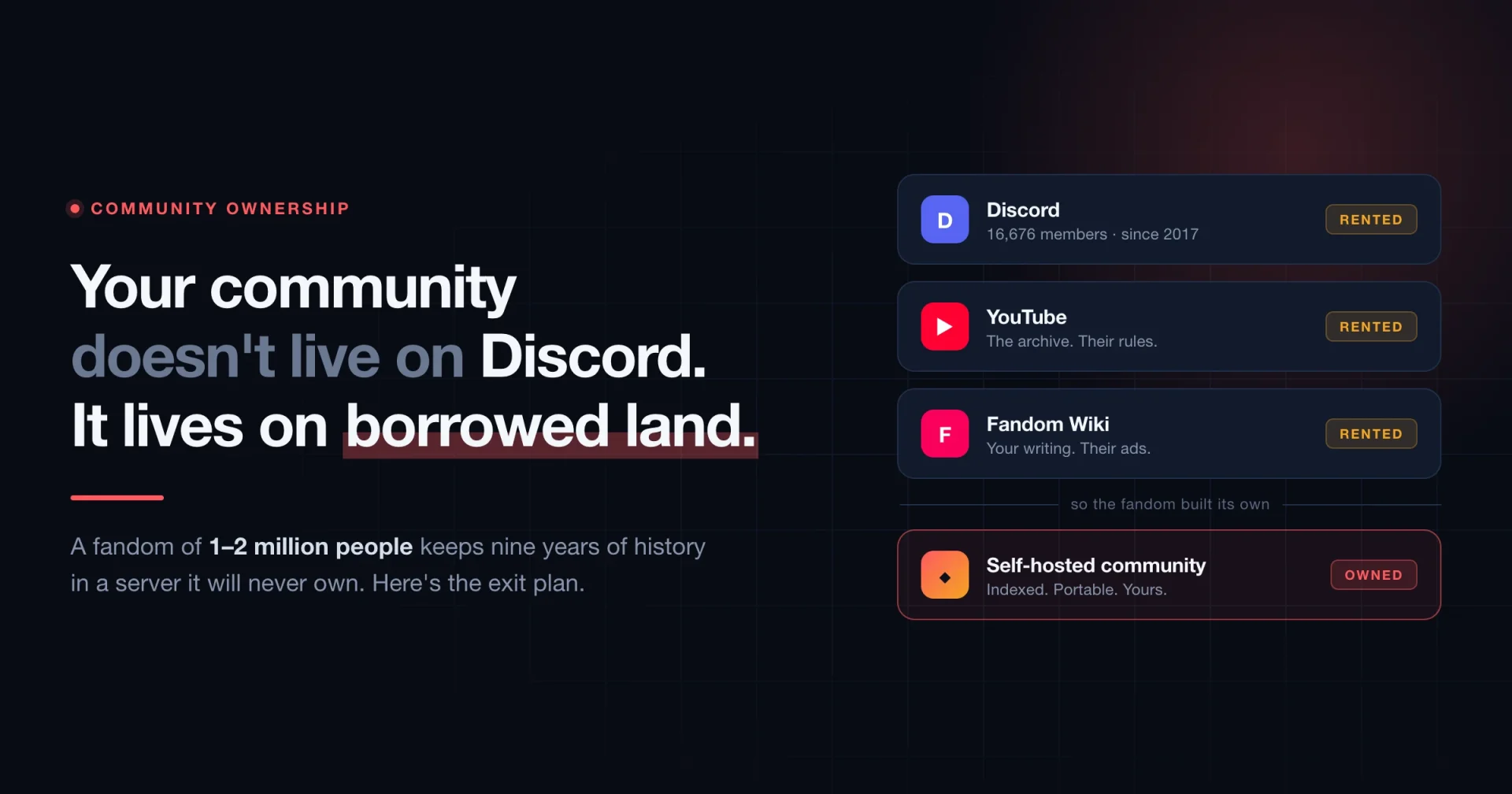
Because this fandom already had somewhere to go. It had, by most counts, somewhere between one and two million people worldwide. It had a Discord server that has been the community’s centre of gravity since August 2017 and now holds 16,676 members. It had wikis, YouTube channels, art archives, and nine years of accumulated culture.
And a group of them still decided the sane move was to start over on a domain they paid for themselves.
If you run a community, a fandom, a customer base, a course cohort, a professional network, that decision should interest you a great deal. Because the thing they were escaping is the thing almost every online community is standing on right now.
One fandom, six platforms, zero ownership
Ask where the object show community lives and you do not get an answer. You get a list.
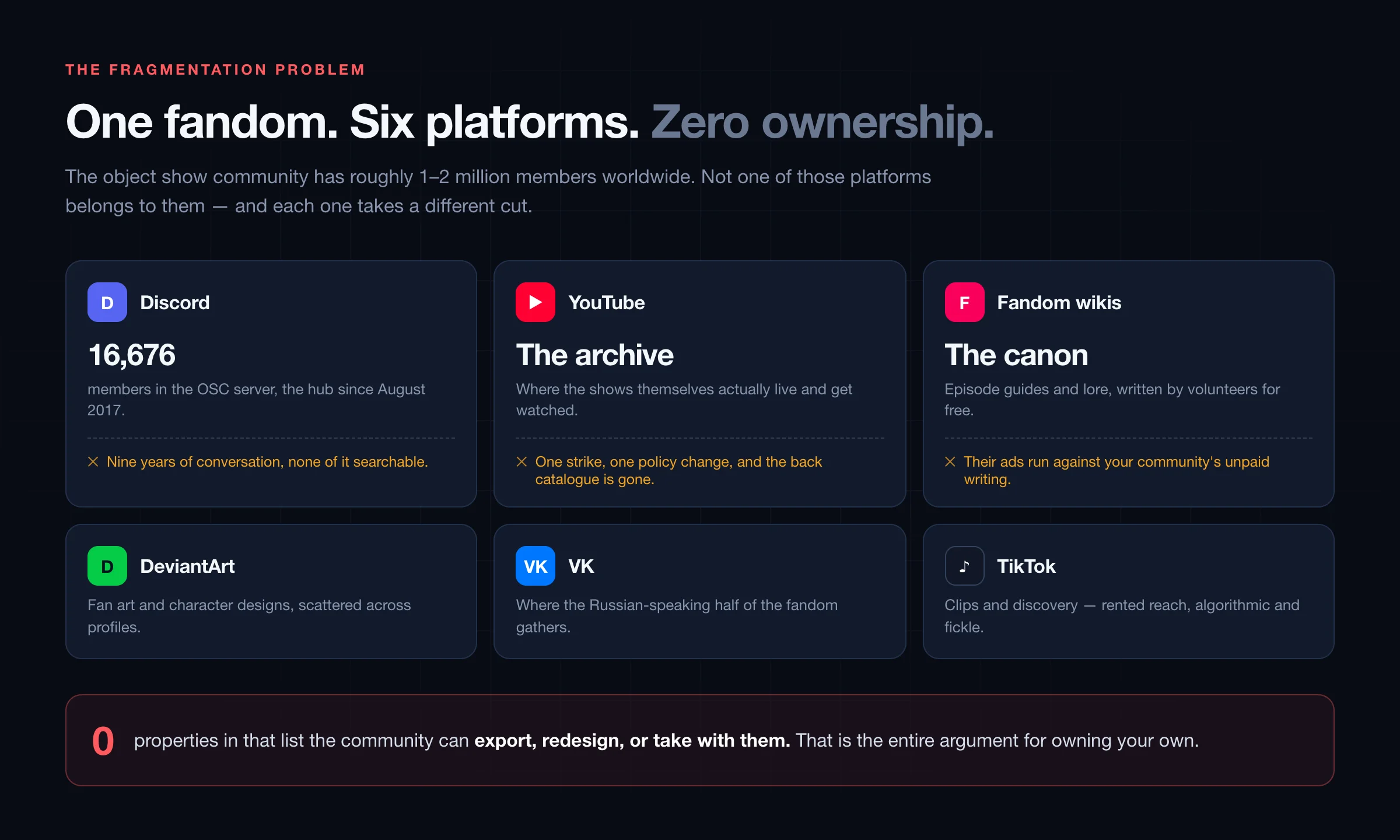
The shows are on YouTube. The conversation is on Discord. The lore and episode guides are on Fandom wikis. The art is on DeviantArt. The Russian-speaking half of the fandom gathers on VK. Clips and discovery run through TikTok and X.
Every one of those is somebody else’s property. Not one of them can be exported, redesigned, merged, or carried anywhere. The community produced all the value on them and holds title to none of it.
This is not a fandom problem. Swap the nouns and it is the shape of nearly every community built in the last decade. Your customers are in a Facebook Group. Your power users are in Slack. Your documentation is in Notion. Your tutorials are on YouTube. It feels like infrastructure. It is a lease.
What borrowed land actually costs
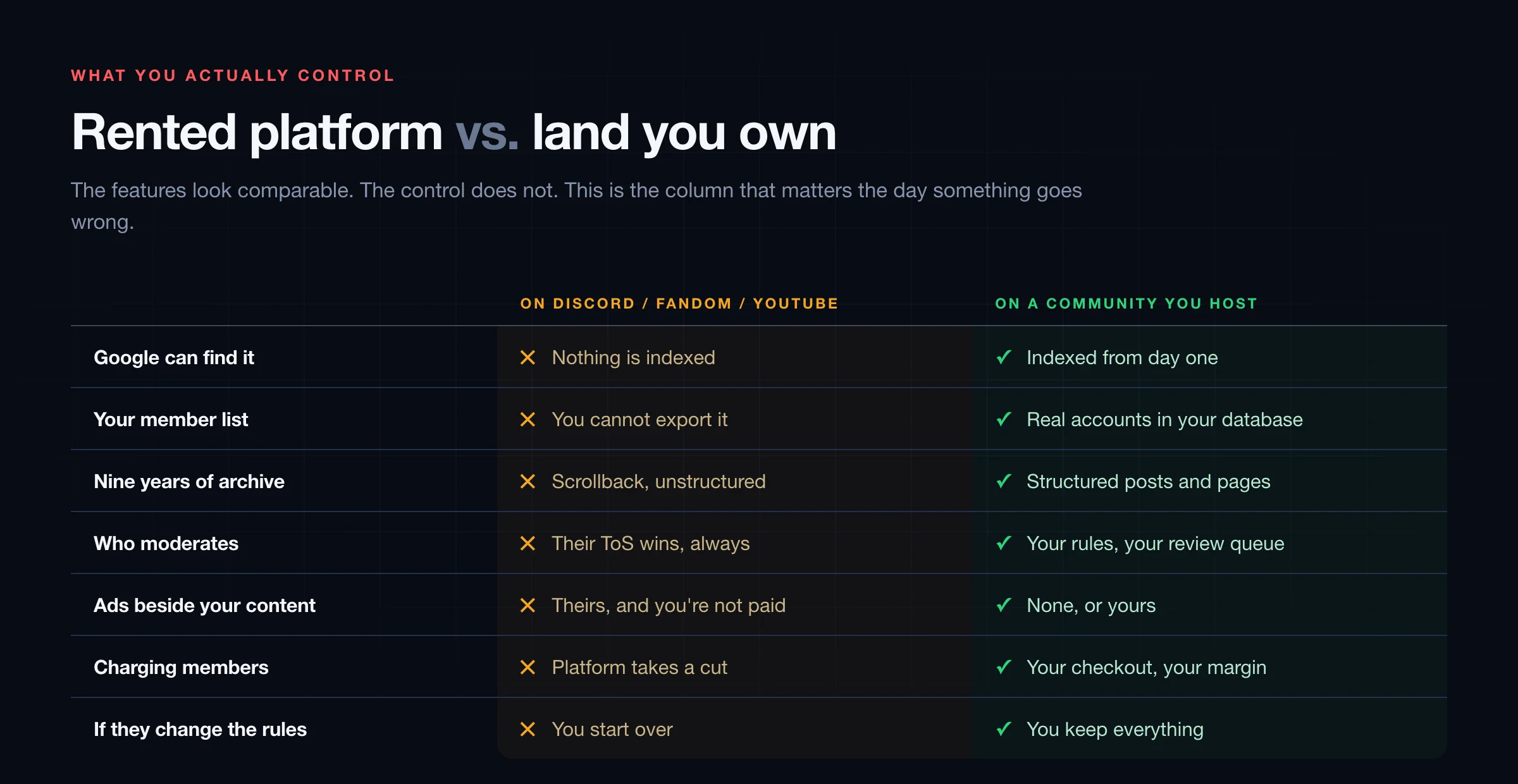
“Discord is free” is true and beside the point. The rent is not charged in money. It is charged in five other currencies, and you pay all of them.
1. Nine years of answers that Google has never seen
This is the expensive one, and it is almost invisible because nothing about it ever shows up as a loss.
Since 2017, members of that Discord have answered the same questions thousands of times. How do you get started animating an object show? What software do people use? How do you structure an elimination format? Every one of those answers was typed out, read by the handful of people online at that moment, and then scrolled into the dark.
None of it is indexed. None of it is searchable from outside. None of it has ever brought one new person into the community. Nine years of genuine expertise generating exactly zero discovery.
Put the same answers on a public site and each one is a permanent, crawlable asset that recruits for you while you sleep. That is the difference between a conversation and a library.
2. A member list you can never take with you
16,676 people is a serious audience. Try to email them.
You cannot. You do not have their addresses. You cannot export the roster. You cannot segment it, survey it, or reach anyone who is not looking at the app right now. You have a number on a screen and no way to act on it.
The roster is the single asset that determines whether a community survives a platform change, and on a rented platform it is the one asset you are structurally prevented from holding.
3. Your members’ unpaid writing, monetised by someone else
Fandom wikis are written by volunteers. Every episode guide, character page and timeline was researched and typed by a fan for free.
Ads run against that work. The revenue does not go to the people who wrote it, and it does not go to the community that organised it. If the wiki host changes its layout, its ad density, or its terms, nobody who built the thing gets a vote.
4. One policy change from starting over
This is the risk everyone acknowledges and nobody prices in.
A YouTube policy shift, a Discord ToS revision, a wiki host’s redesign, a single overzealous automated strike, any of these can remove years of community history overnight, with no appeal that resolves in a useful timeframe. It does not have to be malice. Platforms change because their business changes, and your community is not part of that calculation.
5. No way to turn any of it into a living
This one only matters to some communities, but where it matters it decides whether the thing survives.
Moderating 16,000 people is work. So is maintaining an episode index, running events, and keeping a wiki accurate. Communities that reach real scale eventually need someone doing that work on purpose rather than heroically, in their spare time, until they burn out and quietly disappear.
On a rented platform your options are the ones the landlord sells you, at the landlord’s rate, with the landlord’s rules about what you may charge for. On your own domain, membership tiers and checkout are just another part of the stack, and the difference between a 3% processing fee and a 30% platform cut is the difference between a community that can pay a moderator and one that cannot.
If that is the direction you are heading, the mechanics are worth understanding before you commit to a platform: we compared seven WordPress subscription plugins with real pricing and honest trade-offs, and looked at what the WooCommerce data actually says about why subscribers cancel. Both are worth reading before you charge anyone anything.
Platform risk is not hypothetical
Everything above sounds like a thought experiment until you look at what has already happened to communities that were exactly as confident as yours.
Google+ gave communities about eight weeks
Google+ hosted a genuinely large ecosystem of Communities, hobby groups, professional networks, fandoms, some of them years deep and tens of thousands of members strong.
The consumer shutdown was announced with a hard date of 2 April 2019. From 4 February the platform stopped accepting new profiles, pages, communities and events. Community owners and moderators were given a tool in early March to download their community’s posts, author, body and photos.
That is roughly a two-month window, with a data export that arrived a few weeks before the lights went out, to rescue what in some cases was half a decade of community history. Plenty of owners never saw the announcement in time. Their communities simply stopped existing.
Worth noting what triggered it: a data exposure affecting up to 500,000 profiles, then a second bug affecting around 52.5 million users. The communities on the platform did nothing wrong and had no input. The landlord had a problem, so the building came down.
Reddit repriced the API and 8,000 subreddits went dark
On 18 April 2023, Reddit announced it would begin charging for API access from 1 July. The rate was 24 cents per 1,000 requests.
For Apollo, a third-party Reddit client that many moderators used to actually do their moderation, that arithmetic came to roughly 7 billion requests a month, about $2 million a month, or around $20 million a year. Apollo shut down on 30 June 2023.
On 12 June, more than 8,000 subreddits went private in protest. It changed nothing. The pricing shipped.
Note that Reddit did not shut down and nobody’s content was deleted. This is the milder version of platform risk, and it still meant that thousands of communities discovered simultaneously that the tools they depended on were revocable, that their collective bargaining power was zero, and that a pricing decision made in a room they were not in could break their operations in ten weeks.
Neither of these events was malicious. Both were ordinary business decisions. That is exactly the point, you do not have to assume bad faith to conclude that you should not build on someone else’s foundation.
What owning it actually looks like
The counter-argument to self-hosting used to be strong: you would spend six months and a five-figure budget rebuilding a worse Discord. That was a fair objection in 2018. It is not one now.
Here is a community running on WordPress, on a laptop, with no custom development. Everything below is stock configuration.
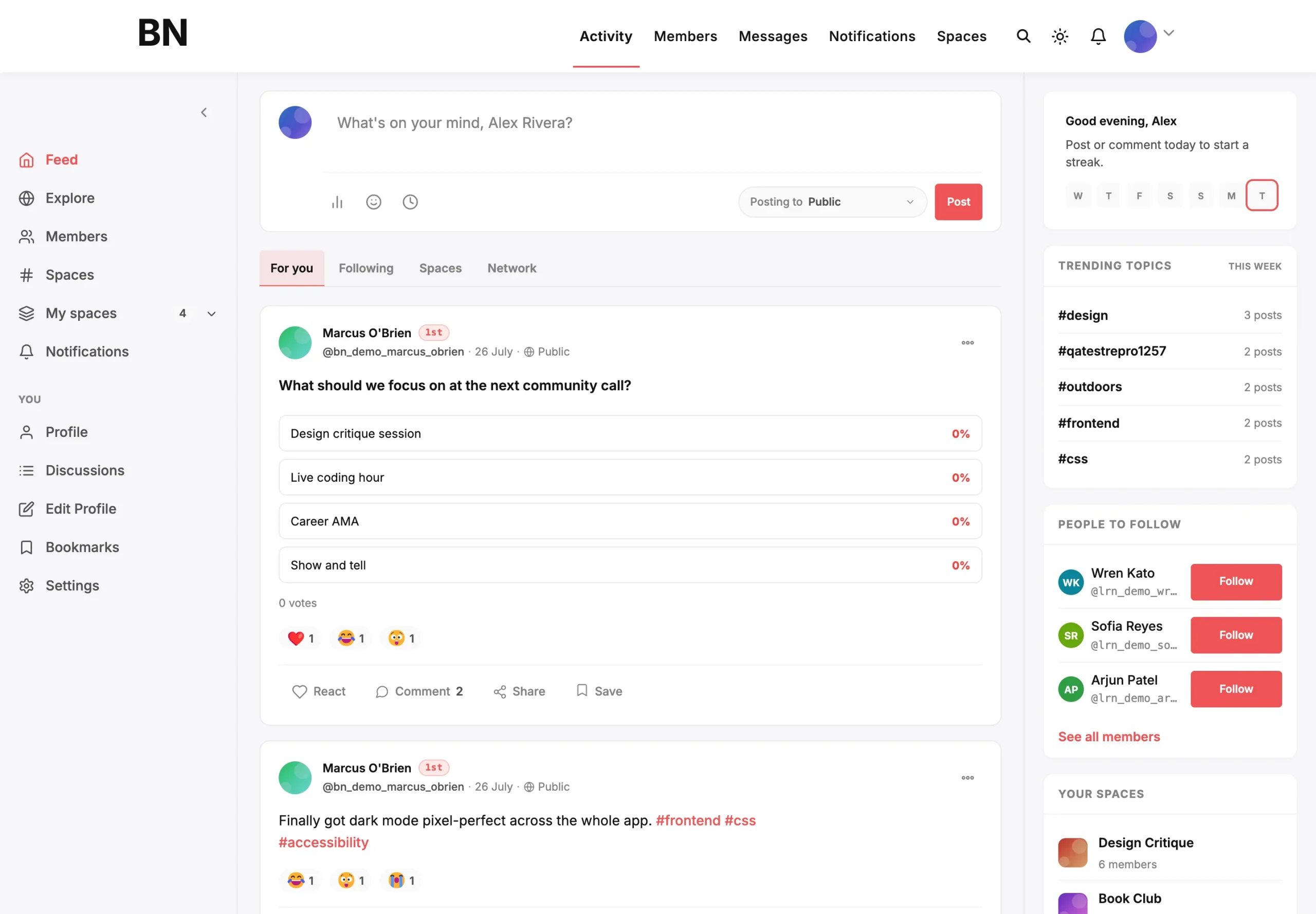
The feed does what a chat platform does, posting, reactions, comments, polls, hashtags, sharing, bookmarks. The difference is underneath. Every post has a permanent URL. Every hashtag is a real archive page. Every answer a member writes is a document search engines can reach.
Sub-communities map onto the structure fandoms already use. An object show community would want a space per show, plus general, help, off-topic and announcements, which is exactly how the Discord is already organised, minus the part where the categories are invisible to everyone outside the server.
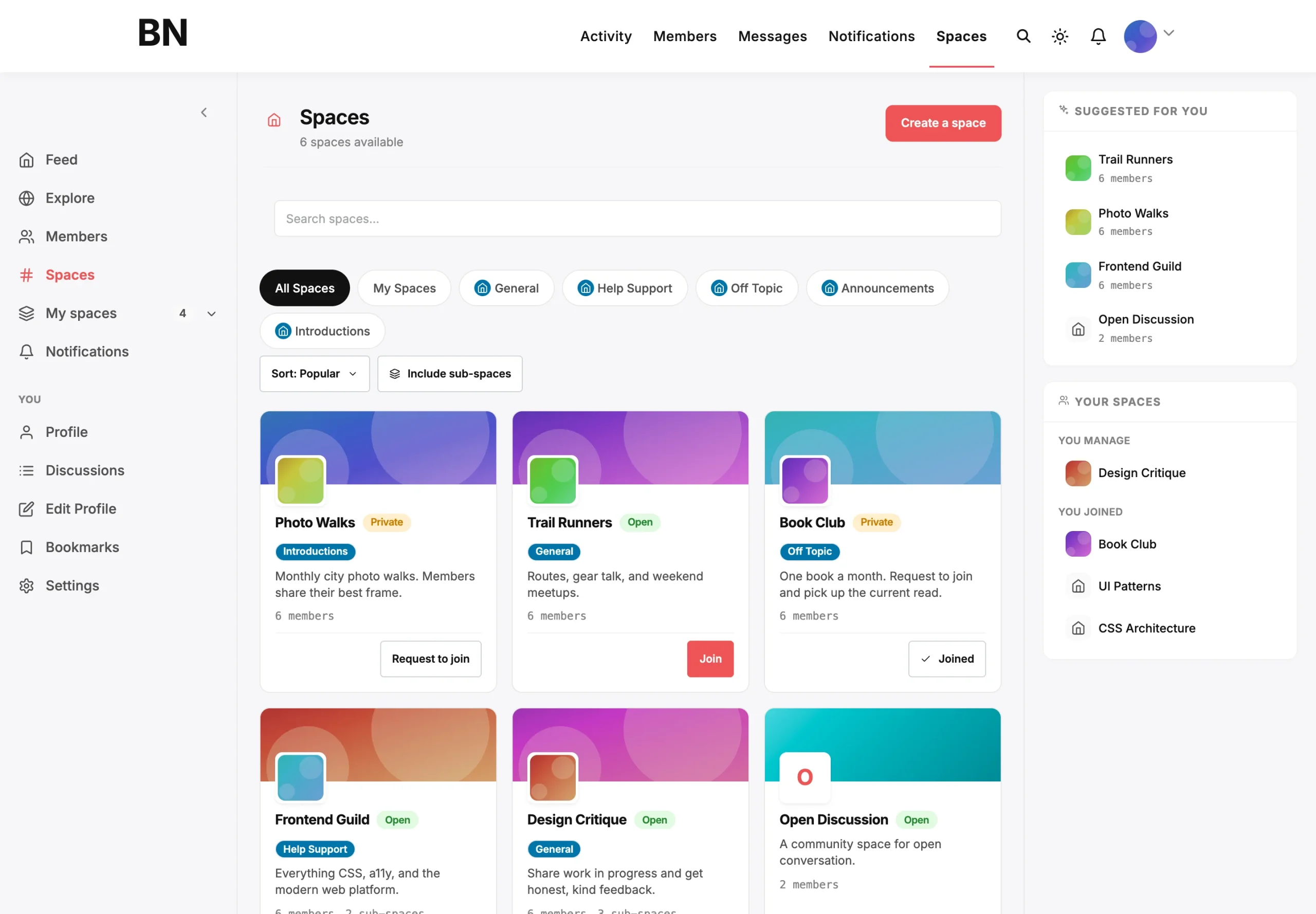
Privacy is per space, not all-or-nothing. Public spaces get indexed and pull in new members. Private spaces stay genuinely private. You decide which is which, rather than accepting one global setting from a platform that is optimising for something other than your community.
And the roster is a real roster.
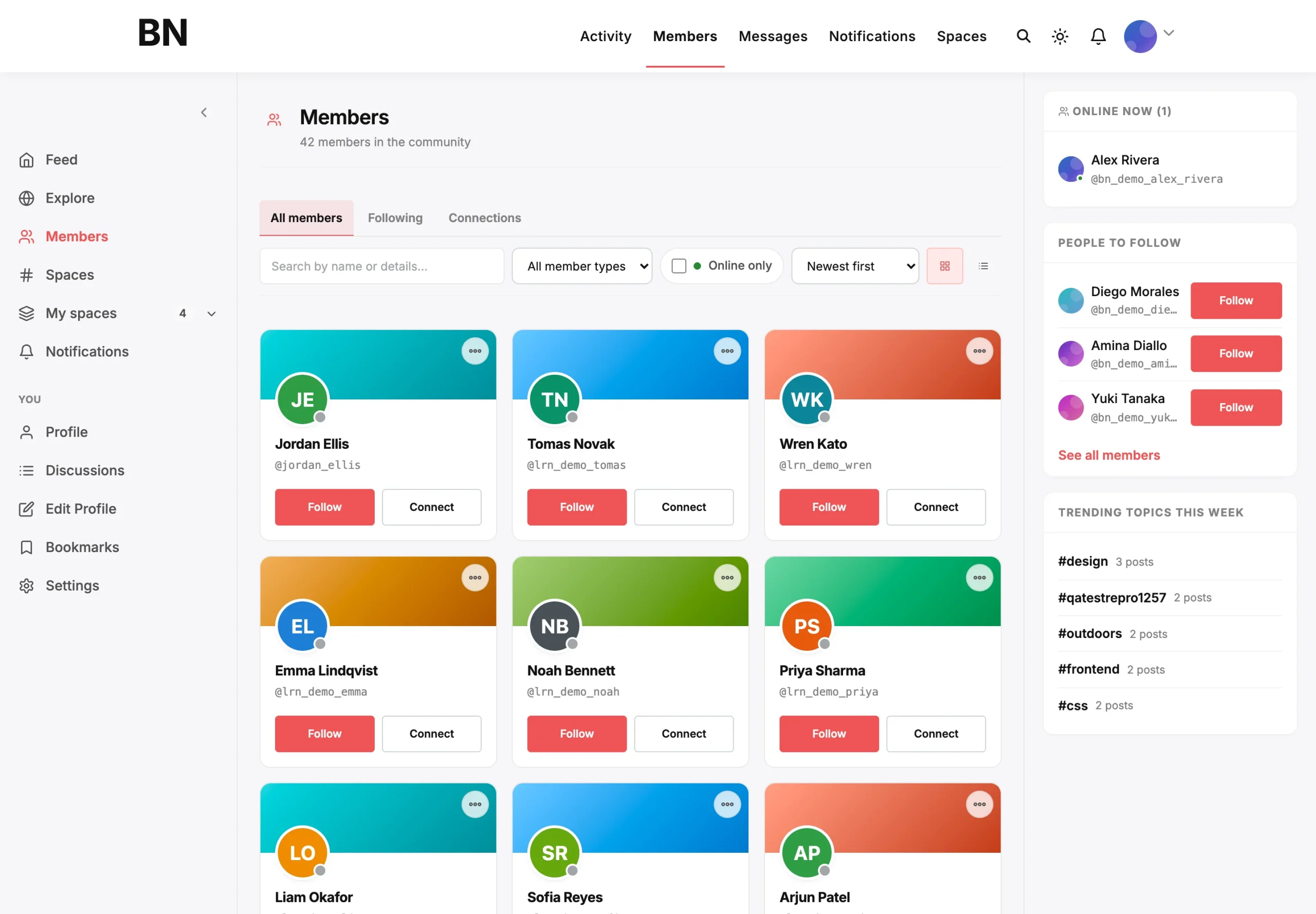
These are WordPress users. You can query them, segment them by member type, email them, and export the lot to CSV whenever you want. That single capability is the whole argument compressed into one sentence.
The stack here is BuddyNext on WordPress, but the specific plugin matters less than the property line. Any self-hosted community platform gives you the same thing the rented ones cannot: a database you can back up and a domain you own.
The exit plan: you don’t leave Discord, you outgrow it
Here is where most of these migrations die.
Someone reads an article like this one, gets righteously annoyed about platform risk, announces that the community is moving, and posts a link to an empty forum. Two hundred people sign up. Eleven come back. Six weeks later the new site is a ghost town and the Discord is busier than ever, and now everyone is a little more cynical about the next attempt.
Nobody migrates 16,000 people in a weekend. Do not try. Move what the chat platform is worst at, and leave the chat exactly where it is.
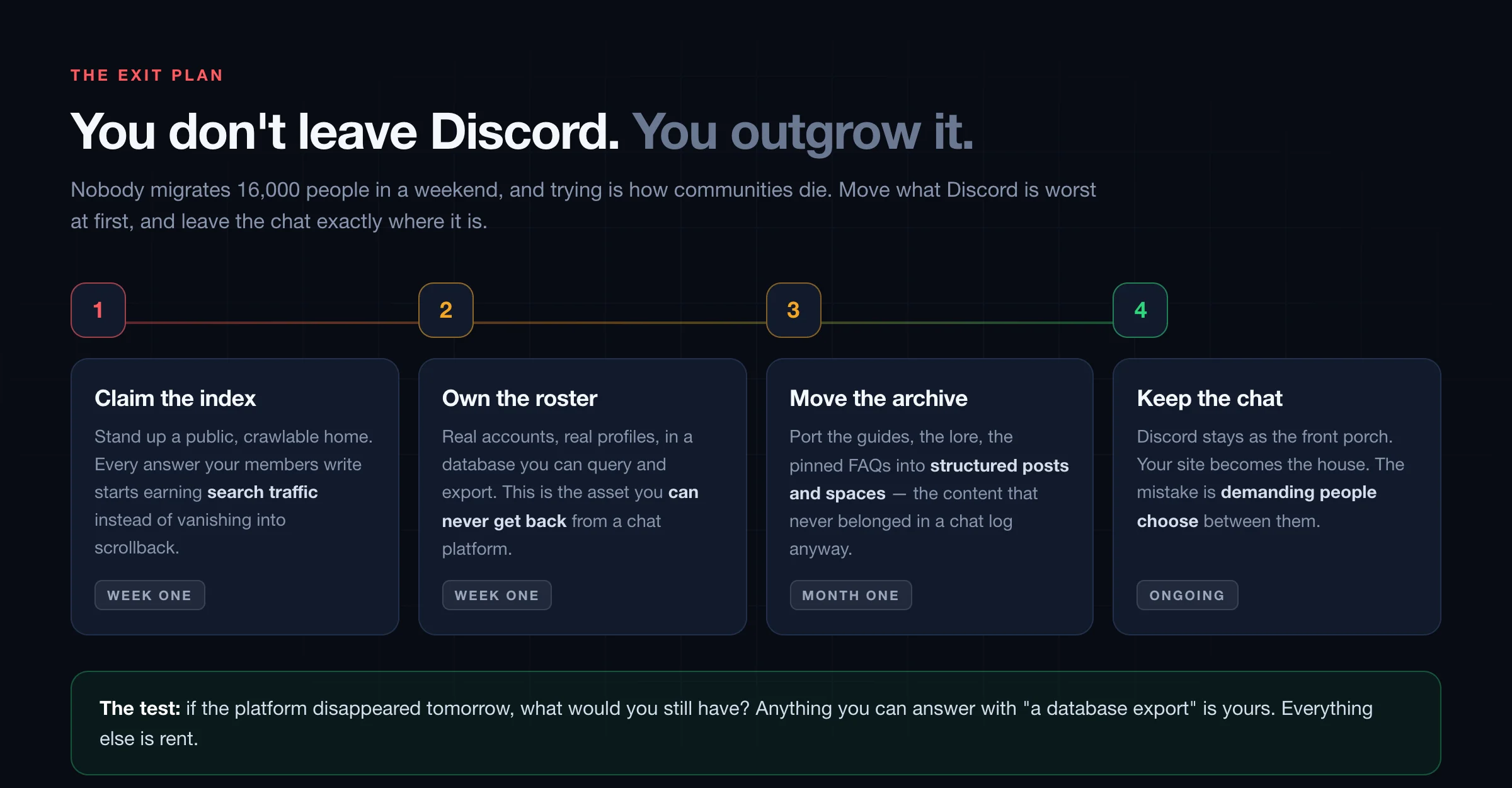
Phase 1, Claim the index
Stand up a public, crawlable home. Do not announce a migration. Do not ask anyone to leave anything.
Take the twenty questions your Discord answers every single week and write them up properly, once, on pages that Google can reach. This is the phase with the best return and the least social risk, because it costs your members nothing and starts compounding immediately.
Phase 2, Own the roster
Give people a reason to make an account. A profile, a watchlist, a progress tracker, early access, a member directory, Object Stream Community’s watchlist-and-progress feature is a textbook example of an account that earns its own existence.
You are not trying to replace the chat. You are converting an anonymous audience into a list you can actually reach.
Phase 3, Move the archive
Guides, lore, pinned FAQs, resource lists, episode indexes. This material was always badly served by chat, it was written once and then buried under a month of conversation within days.
Moving it is not a loss to the Discord. It is a promotion for content that was already in the wrong container.
Phase 4, Keep the chat
This is the one people get wrong, and getting it wrong is fatal.
Discord is genuinely excellent at real-time, low-stakes, high-frequency conversation. Your site will not beat it at that, and you should not try. Keep the server. Let it be the front porch. Your site becomes the house, the archive, the index, the roster, the identity, the thing that persists.
Communities that demand their members choose lose. Communities that give the conversation somewhere permanent to settle win slowly and then all at once.
What to actually stand up in week one
Phase 1 and 2 are the whole ballgame, and they are smaller than people expect. Here is the concrete version.
A domain you control
Registered to a person or entity that will still care in five years, ideally not to whoever happens to be the most technical moderator this month. Communities lose their domains to lapsed renewals and unreachable former admins far more often than to anything dramatic. Put a second person on the account.
Public activity, private where it needs to be
Default your main feed and your general spaces to public so they get crawled. Keep the spaces that need privacy genuinely private. The mistake in both directions is uniformity, a wholly private community gets no discovery, and a wholly public one has nowhere for the real conversation to happen.
Registration that is worth completing
Ask for as little as you can, email, display name, and one profile field that actually feeds a feature. Every additional required field costs you signups, and you can always ask later once someone has a reason to care.
Then give the account something to do on day one. A watchlist, a saved-posts list, a progress tracker, a directory listing, a notification preference, anything that makes the account feel like it belongs to them rather than to your mailing list.
A backup you have actually restored
Daily, off-site, automated. Then, and this is the part everyone skips, restore it once to a staging site and confirm the result is a working community rather than a database full of orphaned rows.
An untested backup is a rumour. The entire argument for owning your platform collapses if the export you were counting on turns out not to work.
How to structure the archive so it actually ranks
Moving your guides onto your own domain does nothing by itself. Structure is what turns an archive into a discovery engine.
One page per recurring question. Not one giant FAQ page with thirty anchors. If your community answers “what software should I start with” every week, that is a page, with that question as the title, answered properly once. Thirty such pages will outperform one page thirty times as long, because each one matches a real query.
Hub pages per topic. A space or category page that links out to every article beneath it, with real editorial copy rather than a bare list. This is what gives search engines a map of your subject and gives new members somewhere to land that is not the homepage.
Let member posts be indexable. The instinct is to keep the feed behind a login. Resist it for the public spaces. A member’s genuinely useful answer, on a permanent URL, is the single cheapest piece of content marketing that exists, you did not write it, and it recruits the next member.
Link out generously. Credit the wikis, the YouTube channels, the creators. It costs nothing, it is the right thing to do, and communities that behave like a good citizen of their niche get linked back to. Object Stream Community routes every episode play through the creator’s own YouTube video rather than re-hosting it, which is both the ethical choice and the one that keeps creators on side.
What you give up by moving
An honest version of this argument has to include the other column, because there is one, and pretending otherwise is how people end up with the ghost town described earlier.
Real-time presence. Discord’s core magic is seeing that eleven people are around right now. A forum-shaped site does not replicate that feeling, and the ones that try usually end up with a worse chat bolted to the side.
Zero-friction onboarding. An invite link versus a registration form is not a close contest. You are trading conversion rate for an actual relationship, which is the right trade, but it is a trade.
Voice and screen share. If your community runs on voice, keep the voice where it is. Nothing self-hosted is going to match it, and you should not spend six months finding that out.
Someone else’s mobile app. Their native app has a team behind it. Yours will not, at least not at first.
This is precisely why phase 4 says keep the chat. You are not trying to win those four things. You are trying to stop the archive, the roster, and the index from being someone else’s property. Those are different problems, and only one of them requires you to move.
The three objections worth answering
“Discord is free and hosting is not”
Correct. A small community site runs somewhere in the region of ten to thirty dollars a month, and a self-hosted community platform on WordPress is usually free or a modest one-off.
Weigh that against the five costs above, particularly nine years of expertise that has never once appeared in a search result. The rented option is not cheaper. It is billed in a currency that does not show up on a card statement.
“My members will never move”
They will not, and the plan above does not ask them to. Phases 1 to 3 are additive. Nobody loses anything, nobody is asked to change a habit, and the community gets a searchable archive and a real roster out of it.
If you find yourself writing an announcement that starts “we’re moving to…”, stop and re-read phase 4.
“SEO takes forever”
It takes months, which is precisely why the honest answer is that the best time to start was 2017.
A community that had been publishing its answers publicly since then would today own the search results for its entire subject. Instead those answers are in a scrollback nobody can reach. The second-best time is this week.
The test
There is one question that settles this for any community, and it takes about four seconds to answer.
If the platform disappeared tomorrow, what would you still have?
Anything you can answer with “a database export” is yours. Everything else is rent.
A group of object show fans ran that test, did not like the answer, and started building on ground they own. They are four people in Italy funding a closed beta on Kickstarter, which is a fairly small operation to be teaching this lesson to everyone else.
Run the test on your own community before something else runs it for you.
Sources
- Object Stream Community, the platform, in closed beta
- Object Stream Community on Kickstarter, project scope and team
- Object show community, fandom size and where members gather
- The OSC Discord server, member count and founding date
- Google’s own FAQ on the Google+ shutdown, dates and the community data export
- Reddit API controversy, pricing, timeline and the subreddit blackout
- Apollo shuts down over Reddit’s API pricing, the request volumes and the cost