
Managing a WooCommerce store can become a complex task, especially when dealing with multiple vendors, products, or customers. WooCommerce Frontend Manager Plugins are the perfect solution to streamline your store’s operations, offering vendors and store admins a user-friendly way to manage orders, products, and more—directly from the frontend. These plugins not only improve efficiency but also enhance user experience, making them essential tools for any online business. In this blog, we’ll explore the best WooCommerce Frontend Manager Plugins, highlighting their key features, pros, and cons to help you make an informed choice.

What Are WooCommerce Frontend Manager Plugins?
WooCommerce Frontend Manager Plugins are powerful tools designed to simplify the management of WooCommerce stores by allowing vendors and administrators to perform essential tasks directly from the frontend. Unlike traditional backend management, these plugins provide a user friendly and intuitive interface where users can manage products, orders, shipping, and other store functionalities without accessing the WordPress dashboard.
They are particularly valuable for multivendor marketplaces, where multiple vendors need a dedicated space to handle their stores efficiently. By offering frontend access, these plugins reduce complexity, improve workflow efficiency, and empower vendors to manage their stores independently while maintaining centralized control for marketplace admins.
Key Features
1. Vendor Dashboards
Provide vendors with a dedicated, easy-to-navigate dashboard to manage store activities such as product listings, order tracking, inventory, and earnings, all from the frontend.
2. Product Management
Allow vendors and admins to add, edit, or delete products directly on the frontend, often with live editing features for faster updates and real-time visibility.
3. Order and Shipping Control
Include tools to manage orders, update statuses, process refunds, and configure shipping options without needing backend access, streamlining order fulfillment.
4. Analytics and Reporting
Offer comprehensive reporting features, from basic sales overviews to advanced metrics such as commissions, vendor performance, product analytics, and revenue tracking, helping vendors make data-driven decisions.
5. User-Friendly Interface
Provide responsive, intuitive layouts that work on both desktop and mobile devices, ensuring that vendors and admins can manage their stores efficiently anywhere, anytime.
6. Multivendor Support
Enable marketplaces to assign permissions, manage commissions, and control vendor access to different features, ensuring a secure and organized workflow for all participants.
7. Customization Options
Many frontend manager plugins allow for customizable dashboards, templates, and modules, so marketplace owners can tailor the experience to match their branding and operational requirements.
8. Integration with WooCommerce Extensions
Seamlessly integrate with popular WooCommerce extensions such as subscriptions, bookings, and payment gateways, providing a fully functional frontend experience without sacrificing advanced features.
Why They Matter
By shifting store management to the frontend, these plugins reduce the learning curve for vendors, speed up daily operations, and enhance the overall user experience for both admins and sellers. For multivendor marketplaces and stores with multiple contributors, frontend manager plugins are essential tools for efficiency, scalability, and streamlined store management in 2026.
Best WooCommerce Frontend Manager Plugins
1. YITH WooCommerce Frontend Manager
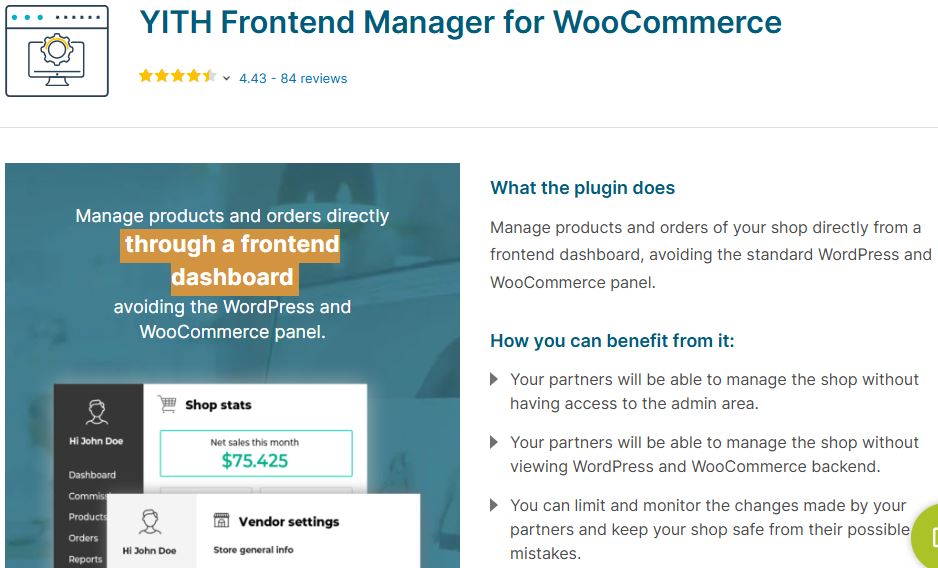
YITH WooCommerce Frontend Manager is a comprehensive frontend management solution designed to make managing WooCommerce stores easier, faster, and more intuitive. It allows vendors and store owners to handle products, orders, and shop settings directly from the frontend, eliminating the need to navigate the WordPress backend. This approach not only simplifies daily operations but also reduces the learning curve for new vendors or store staff.
Key Features
- Allows vendors to edit product details.
- Order management tools.
- Intuitive dashboard for vendors.
Pros
- Reliable and feature-packed.
- Integration with other YITH plugins.
- Simple setup and configuration.
Cons
- Lacks advanced analytics features.
- Limited features in the free version.
- May require premium plugins for complete functionality.
2. WooCommerce Product Vendors
WooCommerce Product Vendors transforms your WooCommerce store into a fully functional and robust multivendor marketplace, providing comprehensive frontend management capabilities that empower vendors to manage their own stores independently. With its intuitive frontend interface, vendors can add, edit, and organize products, track orders, manage inventory, and update shipping details without needing backend access.
Key Features
- Vendor dashboard for product management.
- Detailed commission tracking.
- Vendor reviews and feedback system.
Pros
- Seamless WooCommerce integration.
- Ideal for niche marketplaces.
- Reliable and secure backend.
Cons
- Requires configuration for optimal use.
- Advanced features require premium plans.
- Limited support for non-standard WooCommerce themes.
3. WCFM – WooCommerce Frontend Manager
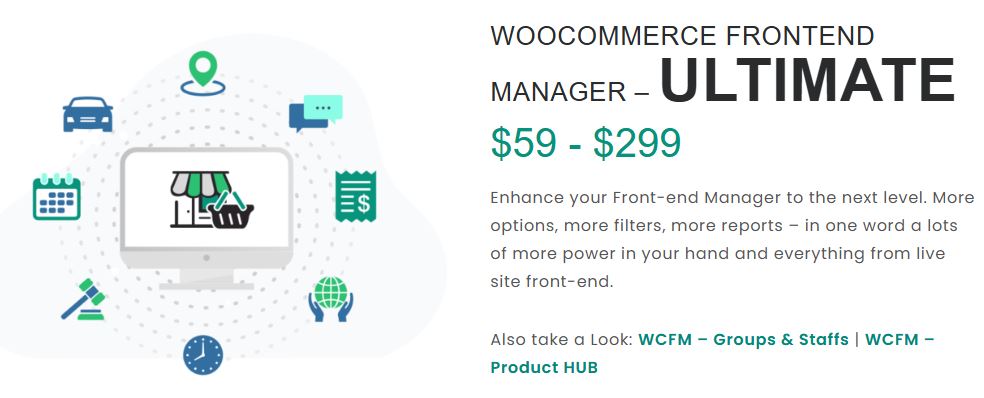
WCFM (WooCommerce Frontend Manager) is one of the most popular and feature-rich frontend management plugins for WooCommerce, making it an ideal choice for both single-store owners and multivendor marketplaces. Designed to simplify vendor management, WCFM provides a sleek, intuitive, and fully responsive interface that allows vendors and store admins to manage their stores efficiently without accessing the backend.
Key Features
- Product management and live editing.
- Vendor dashboard with analytics.
- Integration with popular multivendor plugins.
Pros
- Intuitive interface for vendors and admins.
- Extensive customization options.
- Free and premium versions available.
Cons
- Advanced features locked in premium plans.
- Steeper learning curve for beginners.
- Requires additional plugins for full functionality.
4. WooCommerce Frontend Shop Manager by Common Ninja
WooCommerce Frontend Shop Manager by Common Ninja is a dynamic and modern plugin designed to streamline store management by allowing vendors and store owners to handle all essential operations directly from the frontend. It eliminates the need to navigate the WordPress backend, providing a user-friendly interface that simplifies tasks like product management, order tracking, and inventory updates.
Key Features:
- Intuitive frontend dashboard for vendors.
- Real-time product and order management.
- Drag-and-drop customization for layouts.
Pros:
- User-friendly interface for non-technical users.
- Fully responsive for mobile and tablet use.
- Easy integration with other WooCommerce plugins.
Cons:
- Limited advanced features in the free version.
- Customization options may require coding knowledge.
- Support response time could be improved.
Also Read: 5 Best WooCommerce Terms and Conditions Popup Plugins
5. Dokan Frontend Dashboard
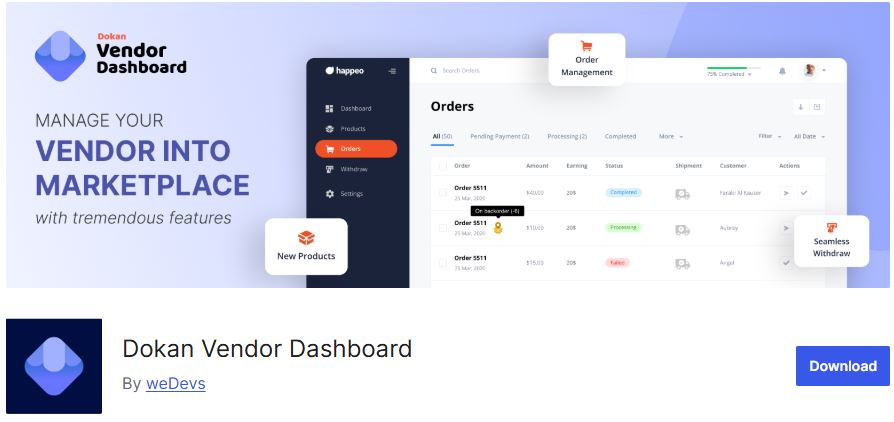
Dokan is a renowned multivendor WooCommerce plugin that stands out for its comprehensive frontend dashboard, allowing vendors to manage their stores independently without needing backend access. Its intuitive interface makes it easy for vendors to add, edit, and organize products, manage inventory, update pricing, and handle product variations directly from the frontend.
Key Features
- Store-specific dashboards for vendors.
- Integrated analytics and reporting.
- Product and order management tools.
Pros
- Perfect for multivendor marketplaces.
- Highly scalable with premium add-ons.
- Responsive and mobile-friendly.
Cons
- Premium version can be expensive.
- May require technical expertise for setup.
- Limited support in the free version.
6. WC Vendors Pro Frontend Manager
WC Vendors Pro is a robust and highly scalable multivendor WooCommerce plugin that provides comprehensive frontend management features for both marketplace owners and vendors. Designed to support growing and complex marketplaces, it allows vendors to manage products, inventory, pricing, and product variations directly from an intuitive frontend dashboard, eliminating the need for backend access.
The plugin also offers advanced order management tools, enabling vendors to track order statuses, process refunds, handle shipments, and communicate efficiently with customers. Marketplace owners benefit from detailed commission tracking, flexible payout schedules, and vendor performance analytics, ensuring smooth financial management and transparency across the platform.
Key Features
- Frontend vendor dashboards with product and order management
- Commission tracking and payout management
- Vendor-specific reports and analytics
- Integration with WooCommerce Subscriptions and Bookings
Pros
- Highly scalable for growing marketplaces
- Extensive customization options
- Strong support and active development
Cons
- Premium pricing for full functionality
- Setup can be complex for beginners
Why It Stands Out
WC Vendors Pro is ideal for marketplaces that require advanced vendor control and detailed reporting, supporting global operations with multiple vendors.
Also Read: 12 Best WordPress Plugins for Schema Markup in 2026 to Rank Higher
7. MarketPress Frontend Manager
MarketPress Frontend Manager is a user-friendly WooCommerce plugin designed to simplify store management while giving vendors a clean, intuitive, and responsive dashboard. It allows vendors to manage their products, orders, and store settings directly from the frontend, eliminating the need to navigate the WordPress backend.
With MarketPress, vendors can add, edit, and organize products, update pricing, manage inventory, and configure product variations in real time. The plugin also includes order management features, enabling vendors to track orders, update statuses, process refunds, and communicate with customers efficiently. Its dashboard provides quick access to sales reports, earnings summaries, and performance metrics, allowing vendors to make informed business decisions.
Key Features
- Product management with drag-and-drop editing
- Order tracking and status updates from the frontend
- Vendor-specific analytics and commission tracking
- Mobile-friendly, responsive design
Pros
- Easy to use for vendors of all experience levels
- Lightweight and fast-loading
- Good support for smaller marketplaces
Cons
- Limited advanced features compared to WCFM or Dokan
- Some customizations may require coding knowledge
Why It Stands Out
MarketPress Frontend Manager is ideal for small to mid-sized stores that need a simple but effective frontend management solution.
Also Read: 15 Best WordPress SEO Plugins to Boost Your Rankings in 2026
8. MultiVendorX Frontend Dashboard
MultiVendorX, formerly known as WC Marketplace, is a flexible and feature-rich multivendor solution for WooCommerce that offers a robust frontend dashboard for vendors. This plugin enables vendors to manage their stores independently, including product listings, inventory, pricing, and variations, all from an intuitive frontend interface without accessing the WordPress backend.
In addition to product management, MultiVendorX provides comprehensive order management tools, allowing vendors to track order statuses, process refunds, manage shipments, and communicate with customers directly from the dashboard. Marketplace owners benefit from advanced commission management, flexible payout schedules, and detailed reporting, making it easier to oversee vendor performance and revenue distribution.
Key Features
- Vendor dashboards for product, order, and coupon management
- Commission management with flexible payout rules
- Advanced reporting for vendors and admins
- Integration with WooCommerce subscriptions, bookings, and payment gateways
Pros
- Highly flexible and developer-friendly
- Supports international vendors with multiple currencies
- Active updates and strong community support
Cons
- Free version has limited features
- Steeper learning curve for beginners
Why It Stands Out
MultiVendorX is ideal for marketplaces seeking a feature-rich, extensible, and globally compatible frontend management system.
9. WC Marketplace Frontend Manager

WC Marketplace Frontend Manager is a modern, all-in-one WooCommerce plugin designed to provide a comprehensive frontend management solution for multivendor stores. It enables vendors to manage their products, orders, inventory, and store settings directly from an intuitive frontend dashboard, removing the need for backend access and simplifying daily operations.
Vendors can add, edit, and organize products, manage stock levels, update pricing, and handle product variations seamlessly. The plugin also offers order management tools, including order tracking, status updates, refund processing, and customer communication, ensuring smooth store operations.
Key Features
- Vendor dashboard with product, order, and shipping management
- Customizable vendor commissions and payout schedules
- Advanced analytics and reporting for vendors
- Integration with popular WooCommerce extensions
Pros
- Complete marketplace solution with frontend focus
- Scalable for large stores
- Supports multilingual and multi-currency setups
Cons
- Some features require premium add-ons
- Initial configuration can be complex
Why It Stands Out
This plugin is perfect for marketplaces that prioritize frontend usability, scalability, and vendor independence, ensuring a smooth experience for both admins and sellers.
Also Read: 15 Best Google Analytics Plugins for WordPress You Need in 2026
Benefits of Using WooCommerce Frontend Manager Plugins
Simplified Store Management: Vendors and admins can handle tasks like adding products, tracking orders, and updating inventory directly from the frontend without backend complexity.
Enhanced User Experience: Provides a more intuitive interface, making it easier for vendors with limited technical expertise to manage their shops effectively.
Time Efficiency: Speeds up processes such as product uploads and order updates by eliminating the need to navigate through the WordPress backend.
Mobile Accessibility: Fully responsive designs allow vendors and admins to manage their stores on the go using smartphones or tablets.
Role-Based Permissions: Enables admins to control vendor actions, ensuring security while allowing sufficient autonomy to vendors.
Integration with Multivendor Marketplaces: Works seamlessly with plugins like Dokan or WC Marketplace, making it ideal for large-scale multivendor operations.

Final Thought on WooCommerce Frontend Manager Plugins
Choosing the right WooCommerce Frontend Manager Plugin can dramatically enhance both efficiency and user experience for your online store. These plugins allow vendors and store owners to manage products, orders, inventory, and analytics directly from the frontend, eliminating the need to navigate the WordPress backend and reducing operational complexity.
Whether you operate a single-vendor shop or a large multivendor marketplace, frontend manager plugins provide the essential tools to streamline workflows, improve vendor productivity, and maintain smooth store operations. Features like intuitive dashboards, responsive design, real-time product editing, order tracking, and commission management ensure that both vendors and administrators can work efficiently and make data-driven decisions.
FAQs
1. What is a WooCommerce Frontend Manager Plugin?
A plugin that allows vendors and admins to manage products, orders, and other store functionalities directly from the frontend.
2. Are these plugins beginner-friendly?
Yes, most offer intuitive interfaces, though some may have a learning curve.
3. Can I use these plugins for a single-vendor store?
Yes, they can simplify store management even for single-vendor setups.
4. Do these plugins support analytics?
Many plugins include basic analytics; advanced features may require premium versions.
5. Are free versions of these plugins sufficient?
Free versions cover basic needs, but premium versions unlock advanced features.
6. Do they work with any WooCommerce theme?
Most are compatible, but checking specific theme compatibility is recommended.
7. Can I integrate these plugins with other WooCommerce tools?
Yes, many support integrations with popular WooCommerce plugins and extensions.
8. Are these plugins mobile-friendly?
Yes, most offer responsive designs suitable for mobile devices.
Interesting Reads